
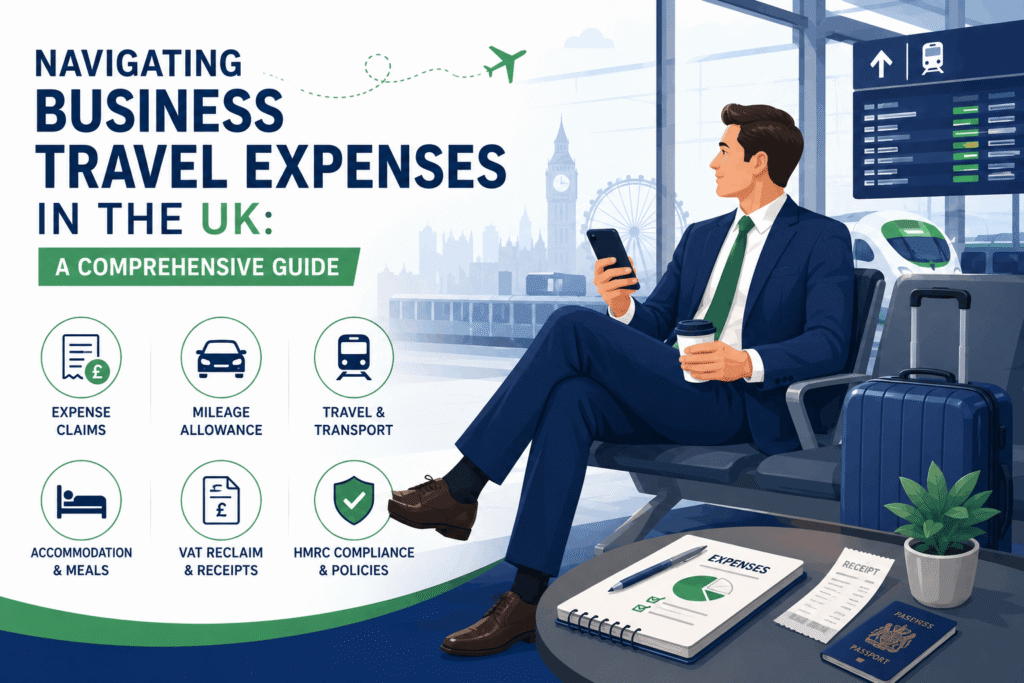
- Navigating Business Travel Expenses in the UK: A Comprehensive Guide
- Business Travel Expenses UK: Why This Matters More Than That Extra Seat Upgrade
- Understanding Business Travel Expenses in the UK (and Why That Monday Commute Doesn’t Count)
- Subsistence Allowance in the UK: Why You Can Claim That Boring Sandwich
- Employee Travel Reimbursement: The Practical, Painless Way (No More Expense Drama)
- Challenges in Managing Travel Expenses (and the Secret Sauce to Fixing Them)
- Tips for Efficient Business Travel Expense Management (or: How Not to Lose Your Mind, Money, or Next VAT Refund)
- FAQ: Business Travel Expenses UK (Because You Were Going to Google These Anyway)
- Why Keeping Up with HMRC Travel Expense Changes is Non-Negotiable
- Ready to Wave Goodbye to Paperwork Panic?
Navigating Business Travel Expenses in the UK: A Comprehensive Guide
Business Travel Expenses UK: Why This Matters More Than That Extra Seat Upgrade
Let’s talk brass tacks: managing business travel expenses UK isn’t sexy—it’s not going to jump off your LinkedIn with the razzle-dazzle of AI-powered-disruption-synergy-ROI. But here’s the cold, hard fact: how you handle travel expenses could quietly decide whether your business is thriving…or treading water in an HMRC audit.
Think about it: Every day, businesses across the UK haemorrhage cash from poorly tracked receipts, messy spreadsheets, and misunderstandings of what’s actually claimable. Meanwhile, the folks at HMRC aren’t exactly known for their forgiving nature if your paperwork’s a hot mess or your claims… let’s say, “creative.” One wrongly filed trip to a “business” steakhouse, and suddenly you’re sweating through tax season.
But here’s the magic. Getting control over travel expenses isn’t just about compliance—though nobody likes a letter from HMRC. It’s a business growth move. Numbers don’t lie: UK SMEs that master expense management shave 10–20% off their T&E budgets, simply by plugging the leaky holes most companies ignore. For insights on compliance and cost-saving strategies, read our guide on https://blog.expensehub.io/understanding-compliance-in-expense-management/.
And managing this without losing your marbles? That’s where modern tools like Expense Hub stroll in, pulling your expenses together faster than you can say “cheeky Nando’s invoice.” We’ll get back to how digital tools automate your paper-chasing nightmares. Promise. For more on automating your financial processes, check out our post on https://blog.expensehub.io/the-role-of-automation-in-the-modern-financial-analyst-toolkit/.
So, whether you’re a founder, the finance lead, or the long-suffering soul tasked with tracking receipts from Bristol to Birmingham, here’s your no-nonsense, story-packed, totally HMRC-compliant guide to business travel expenses in the UK. Let’s make your money work harder—and your record-keeping airtight.
Understanding Business Travel Expenses in the UK (and Why That Monday Commute Doesn’t Count)
Before we get too deep in the spreadsheet weeds, let’s define our terms—and, crucially, separate business travel from that bleary-eyed train ride to the office.
What Are Business Travel Expenses, Really?
Picture this: Janice, your sales superstar, boards a train from Manchester to pitch a client in London. Her ticket? Business travel expense. The coffee she grabs while prepping her deck at a café near the client’s office? Also fair game (if it’s part of necessary subsistence). The overnight stay because the meeting ran late? Yup, that too.
But—and here’s the kicker—her usual train from home to your Manchester office each morning? Sorry, Janice, that’s ordinary commuting, and HMRC won’t let you expense that, no matter how much you hate the Northern Rail delays. The difference between travel “wholly, exclusively, and necessarily” for business, versus getting to and from your regular place of work, is the first critical compliance trap. (And yes, HMRC check this. A lot.)
What’s on the “Eligible” List? (And What’s a Hard Pass?)
Common eligible business travel expenses in the UK include:
- Transportation (train, coach, taxi, flights)
- Mileage (if driving your own vehicle for work)
- Hotels or overnight accommodation
- Meals (within reason—no champagne breakfasts)
- Parking, tolls, and congestion charges
- Business-related calls, WiFi, or essential incidentals
But let’s pause for a quick napkin math scenario:
If your team takes twenty day-trips a quarter—each submitting for train fares (£80), a meal (£12), a taxi (£15), and a parking receipt (£8)—that’s £2,300 in expenses flying around every three months. Without a consistent process, those numbers slip, mistakes creep in, and sudden “where did that £600 go?” moments arrive.
For an even deeper dive into what counts, peek at our # comprehensive guide on UK travel policies for all the listed dos and don’ts (and a couple of surprises—fun fact, the “extra night” tacked onto a weekend for sightseeing doesn’t count).
How Expense Hub Simplifies the Chaos
Now, all those eligible receipts need wrangling. Here’s where Expense Hub earns its keep—imagine snapping a photo of each receipt, logging your mileage with a couple of taps, and never again squinting at a faded hotel printout dated “2018.” Everything centralised, categorised, and ready for approval—minus the paper cuts and lost paperwork that haunt finance teams. For more on effective travel budgeting, see our https://blog.expensehub.io/tips-to-control-travel-budgets-with-effective-expense-management/.
Expense Hub doesn’t just log your receipts; it builds a bulletproof record for every HMRC box ticked, with a workflow that’s as painless as scanning a QR code for your morning croissant. That’s not just convenient, that’s how you keep your business audit-proof (and your sanity intact).
Subsistence Allowance in the UK: Why You Can Claim That Boring Sandwich
Let’s talk subsistence allowance, because nothing says “business travel in the UK” quite like a meal deal from the service station. But jokes aside, subsistence can be the most misunderstood—and most misused—piece of the expense puzzle.
What Even Is Subsistence?
In HMRC-speak, subsistence means covering the essential extra costs of food, drink, or even a bed for the night, just because you’re away from your normal workplace. That Sainsbury’s salad? Your accommodation at that slightly dodgy Travelodge? Both can be legitimate claims—so long as they’re part of actual, necessary business travel.
But here’s a fun twist: subsistence isn’t “a free pass to fine dining on the boss’s dime.” It’s not meant to subsidise every snack, but to offset reasonable costs that you wouldn’t have incurred if you’d just stayed put at your desk.
HMRC’s Yardstick: “Wholly, Exclusively, and Necessarily”
Sally from ops submits a claim for a tapas feast because “networking’s important.” Sorry Sally, unless she had to eat out because she was away from her base for business, HMRC will start sharpening their pencils. Claims must be:
- Wholly related to the work trip.
- Exclusively incurred because of work (not your weekend in Brighton).
- Necessarily needed (i.e., not “optional”).
That means keep those receipts, jot down the business reason (seriously, write it on the back of the napkin if needed), and don’t go wild.
So, What Does the Allowance Cover? (And What’s Out of Bounds?)
- Covered: Meals, reasonable snacks, non-alcoholic drinks, overnight hotel bills, and sometimes laundry or WiFi if you’re away long enough for it to matter.
- Not Covered: Boozy dinners, out-of-area side trips, or that treat-you-deserve-it spa session.
For further snackable info, check our # understanding subsistence allowance deep-dive, or go straight to the source with the full https://www.gov.uk/hmrc-internal-manuals/employment-income-manual/eim31815 if you fancy reading rules at midnight.
How Expense Hub Navigates Subsistence (So You Don’t End Up Paying Out of Pocket, or in Trouble)
Imagine a platform where every meal, hotel stay, or emergency toothbrush bought on the road gets logged, justified, and reviewed automatically. Expense Hub does just this—instantly matching your receipts to your trip, reminding you of allowance thresholds, and keeping a digital trail that delights rather than baffles your finance team and HMRC. No more “can I claim this?” post-its piling up on the finance desk. For more about optimizing receipt capture, visit our guide on https://blog.expensehub.io/best-receipt-scanner-app-guide.
Employee Travel Reimbursement: The Practical, Painless Way (No More Expense Drama)
Let’s play a game: raise your hand if you’ve ever spent hours shepherding paper receipts, desperately hoping they don’t end up as coffee-ring art.
How the Reimbursement Process Should Work
The classic workflow looks so simple on paper:
- Employee incurs travel cost: Maybe it’s a train ticket to Cardiff or a necessary overnight stay in Leeds.
- Employee submits evidence: Ideally, a clean digital receipt, justification for the expense, and the date. (Not a faded thermal printout and a scribbled IOU.)
- Manager/finance reviews: Checks claims versus policy. Approves, flags, or queries as needed.
- Claim is processed: Money lands in employee’s account. Trust in the system is preserved, and everyone’s (mostly) happy.
But we all know the Reality TV Version—claims are late, receipts are lost to the washing machine, and someone’s always asking “have you seen that email?” three weeks after the month-end rush.
Why Timeliness and Record-Keeping Are Non-Negotiable
Here’s where things get spicy: HMRC’s clock starts ticking as soon as claims get filed. If you submit travel expenses months late or lose vital receipts, claims may be disallowed, or—worse—the business could face penalties for poor record-keeping.
Take it from me, nothing sours a team’s trust faster than waiting six months for train fare reimbursement. For practical tips on streamlining such processes, explore https://blog.expensehub.io/enhancing-expense-reporting-software.
Where Expense Hub Turns “Expense Dread” Into “Expense Done”
Expense Hub automates this entire workflow—employees capture receipts using a mobile app (snap and done), expense lines are checked against your company’s policy, and managers get smart alerts to approve or query claims. Rather than wondering if Rachel’s taxi was for that after-hours gym session, every claim is traceable and legit.
Want to make this process sing? Check out our guide to https://blog.expensehub.io/streamlining-business-expense-report-software, which pulls back the curtain on how companies save hours (and headaches) every month.
Challenges in Managing Travel Expenses (and the Secret Sauce to Fixing Them)
If you’ve worked in business operations, you’ve felt one—if not all—of these travel expense headaches:
Common Nightmares in Business Travel Expense Management
- Receipt Wrangling: That moment when you have to decode a rain-blurred parking ticket or justify why the “meal” on a receipt was for two.
- Policy Pandemonium: Everyone interprets expense rules just a little differently, leading to inconsistency and accidental non-compliance.
- Manual Mayhem: Spreadsheet shuffling, manual entry typos, and chasing paper trails like a relentless scavenger hunt.
- Compliance Catastrophe: Missing documents? Fuzzy explanations? HMRC, in their infinite patience, will be delighted to remind you just how important accurate records are.
- Zero Visibility: Without a digital dashboard, tracking who spent what, where, and why is like trying to catch fog with a butterfly net.
Real-World Example:
A marketing agency lost £12,000 in unclaimed VAT and over-claimed £5,000 in travel—simply because nobody checked the details. When HMRC audited, half those claims went up in smoke.
Expense Hub’s Solution: Digital Expense Management Tools to the Rescue
Here’s your golden ticket: digital tools like Expense Hub feature:
- Automated receipt capture: Snap, store, and digitise in seconds, all readable and indexed.
- Policy smart-checks: The app knows your travel policy better than your most diligent accountant.
- Approval workflows: No more “out-of-office” dead-ends—approvals (or rejections) route instantly to whoever’s next in line.
- Audit-friendly reporting: HMRC could knock on the door, and all you need is a password, not a frantic all-nighter.
Want to see how real teams conquer these challenges? Our https://blog.expensehub.io/maximizing-travel-expense-management-tool article is packed with before-and-after case studies (and a few horror stories that didn’t end well—don’t be them).
Tips for Efficient Business Travel Expense Management (or: How Not to Lose Your Mind, Money, or Next VAT Refund)
Ready for the checklist you’ll actually want to use?
Set Crystal-Clear Travel Expense Policies
Define which expenses fly and which plummet, in language anyone—intern to CEO—can understand.
Example: “No claims for home-to-office travel. Meals are capped at £25/day. Taxi only if no public transport is practical.”
Explain What’s (and Isn’t) Claimable
Nothing torpedoes compliance like ambiguous policies. List everything.
Handy Note: If it’s “grey area,” spell it out (“No claims for room service movies, folks.”).
Digitise Receipt Capture and Categorisation
Forget paper—arm your team with mobile apps that let them photograph, scan, and attach notes to every expense.
Expense Hub’s platform pulls data off receipts automatically. That’s right—no more typing in the price of that chicken wrap.
Set Approval Limits and Timelines
Decentralise where it makes sense: £30 meal claims can fly through fast; £500 conference bills, not so much.
And timing? Set a “submit within X days” rule so claims don’t age like forgotten cheese.
Reconcile and Audit Like a Pro
Expense claims aren’t “one-and-done.” Regularly reconcile spend against budget, ferret out duplicate claims, and run spot-audits.
Expense Hub’s dashboards crunch these numbers and flag anomalies before they become problems. For an expansive look into how software can assist in financial audits and compliance, read https://blog.expensehub.io/unlocking-efficiency-expense-management-software.
Regular Fraud and Compliance Checks
HMRC expects it, and so should you. Run compliance reports; look for patterns like “switching payment methods” or “inflated mileage.”
Nothing ruins a holiday quicker than a visit from the taxman with receipts in hand.
How Expense Hub Embeds Best Practice
Expense Hub’s automation means every policy is built-in, every claim is checked in real time, and every audit is as easy as logging in. Team members stay on the right side of HMRC (and your finance director’s good books).
FAQ: Business Travel Expenses UK (Because You Were Going to Google These Anyway)
Q: What counts as a business travel expense in the UK?
A: Any travel wholly, exclusively, and necessarily for business, excluding standard commutes. That’s client meetings, site visits, or offsite training—not your daily drive to HQ.
Q: Can meals be claimed while on business trips?
A: Yes, so long as they’re reasonable and directly related to a work trip. Three-course tasting menu? Nice try, but probably only the mains will count.
Q: Are home-to-office commutes claimable?
A: Nope. Think of it as the price of admission to being employed. Even if you live 120 miles away, your regular commute is out-of-bounds for expenses.
Q: What receipts are needed for HMRC?
A: Every single one, clearly showing date, supplier, and amount. Photos or scans are fine—Expense Hub makes receipt storage a breeze.
Q: How do mileage claims work?
A: Calculate business mileage (current HMRC rates apply), keep a log with start/end points, and submit these with your claim. No, mapping “shortcut” detours to the beach are not allowed. To understand mileage reimbursement in detail, view our https://expensehub.io/hmrc-mileage-rates-2025.
Why Keeping Up with HMRC Travel Expense Changes is Non-Negotiable
Here’s another contrarian take: you have to keep your policies as fresh as your coffee.
HMRC rates and rules change—sometimes subtly, sometimes with all the subtlety of a brick through the window. If you miss an update, you might under-claim (leaving money on the table) or over-claim (risking penalties).
Set a quarterly reminder to check the https://www.gov.uk/hmrc-internal-manuals/employment-income-manual/eim31815. If you use Expense Hub, the platform updates policy rates by default. No more midnight spreadsheet marathons.
Ready to Wave Goodbye to Paperwork Panic?
Let’s bring it all home. Business travel expenses UK needn’t be a battleground of missing receipts, endless spreadsheets, or sleepless compliance nights.
- Nail the difference between business travel and regular commutes.
- Keep your subsistence claims tightly managed (and justified).
- Follow a reliable, timely reimbursement process.
- Use digital tools to automate, audit, and breeze through approvals.
- Stay current with HMRC rules so your claims are never out of date.
And if you’re tired of the guessing game—wondering if a taxi receipt will pass muster, or whether you’re missing hidden costs that slice away your profit—it’s time to try something genuinely transformative.
Expense Hub isn’t just an expense tracker; it’s your silent (but deadly effective) watchdog—turning chaos into clarity, compliance into confidence, and paperwork into performance gains. Snap, submit, approve, and move on. No drama, no fuss—just business travel the smart way.
Curious if you can finally ditch the shoebox of receipts for good? # Contact us for a one-on-one walkthrough, or request a demo to see how Expense Hub can turn your business travel from a cost centre into a competitive advantage.
Ready to take control of your finances—and finally enjoy a business trip without the dread of expense claims? Expense Hub’s got your back.