
- Understanding Allowable Business Expenses in the UK: The No-Nonsense Guide
Understanding Allowable Business Expenses in the UK: The No-Nonsense Guide
Ever had that stomach-dropping realization in March that you might have been paying too much tax all year? You know, the “Wait… could I actually deduct my home Wi-Fi?!” moment? If you run a business in the UK—whether your empire consists of you, your goldfish, and a laptop, or a whole team slugging through spreadsheets—understanding allowable business expenses is your golden ticket. It’s the difference between sweating bullets come tax time and grinning like a Cheshire Cat with a wallet heavier than you expected.
Here’s the straight truth: making sense of what you can and can’t claim is not just about pinching pennies. It’s about maximising tax efficiency, staying on HMRC’s sunny side, and freeing up mental bandwidth for what actually matters—growing your business, not running from the taxman. According to https://www.gov.uk/expenses-if-youre-self-employed, allowable business expenses in the UK are essential costs—think stationery, travel, even website costs—that knock down your taxable profit, sometimes by thousands of pounds.
But let’s address the obvious: keeping a tab on these expenses can get out of hand fast. Receipts everywhere, spreadsheets that look like the Matrix, and that nagging doubt: “Will HMRC really believe I spent £452.30 on postage last year?” This is where Expense Hub steps in. It isn’t just glorified bookkeeping software—it’s your jetpack for tracking, categorising, and claiming expenses without the hassle (or the mess).
With that, let’s slice through the jargon, the HMRC legalese, and the urban myths about what you can claim, what you shouldn’t, and how a tool like Expense Hub can keep you comfortably on the right side of the law—and your bank account.
What Are Allowable Business Expenses in the UK?
Let’s start with the basics, but do it the Mike Michalowicz way—because nothing kills good business sense like tax jargon.
Definition & Significance: “The Secret Tax-Cutting Sauce”
If you’re running your business in the UK, “allowable business expenses” are your turbo button for tax reduction. Put simply, they’re the wholly and exclusively business-centric costs you rack up to keep the cash registers ringing. Think of them as the fuel for your rocket—without them, you’re not leaving the launchpad, but with them, you’re blasting past a bunch of unnecessary tax overhead.
So what counts? According to https://www.axa.co.uk/business-insurance/business-guardian-angel/what-are-allowable-expenses/ and https://www.gov.uk/expenses-if-youre-self-employed, if you buy it for work, and it’s not a luxury splurge (hello, gold-plated staplers!), it’ll usually qualify. Here’s some “napkin maths”: Let’s say your business rakes in £40,000 in revenue. You tally up £10,000 in allowable expenses—BAM! You get taxed only on the remaining £30,000. That’s potentially £2,000–£3,000 that doesn’t go to Her Majesty’s coffers (or now, His Majesty’s).
Examples That Actually Happen (No Fairy Tales Here)
- Office Supplies and Stationery: We’re talking everything from notepads to that printer ink you swear disappears by black magic.
- Travel Costs: Train fares, business-use mileage at https://www.gov.uk/expenses-if-youre-self-employed, parking fees—not the croissant at the train station café (unless it was for a client, but tread carefully!).
- Staff Salaries: PAYE, employer’s National Insurance, even the Christmas bonus you hand out, fist-bump style.
- Advertising and Marketing: Website build fees, online adverts, print materials, skywriting (if you must).
- Premises Costs: Rent for your office, utilities, business rates—basically, keeping the lights on and the heating set to British Summer Time “on.”
The AXA guide even throws in fees for accountants and interest on business loans.
“If it feels boring and necessary, HMRC probably lets you claim it. If it feels a little too much fun, probably not.”
Why Accuracy Matters (And How Expense Hub Saves the Day)
We all want to claim everything we can, but have you ever tried explaining “digital unicorn coaching” as a business expense to HMRC? Spoiler: they don’t laugh. This is why categorisation is king, and Expense Hub is your loyal squire. By automating the entire process—scanning receipts, separating personal from business costs, grouping those Starbucks runs (that were actually for genuine client meetings!)—Expense Hub makes it borderline impossible to slip up.
The worst-case scenario? Misclassify or over-claim, and you don’t just lose out on savings—you risk a stern letter (or worse) from the tax office. Expense Hub means you’re always ready for an HMRC audit with clean, clear, categorized records.
Want to level up your tax efficiency? Learn more about tax efficiency—because one time-saving hack is never enough.
Understanding Non-Deductible Expenses UK
Here’s where a lot of businesses trip up—usually with the best intentions and the worst results. “Non-deductible expenses UK” isn’t just a dry accounting line. It’s the list of things you wish you could claim (but absolutely cannot), and getting it wrong can mean both financial and legal pain.
What Are Non-Deductible Expenses? (And Why Your Accountant’s Eyes Start Twitching)
Let’s spell it out: non-deductible expenses are the party crashers of your business accounts. They look tempting, sometimes sneak onto your lists, but ultimately get you in trouble.
According to https://www.gov.uk/expenses-if-youre-self-employed, here are the big no-no’s:
- Client Entertainment: That slap-up meal at The Ivy to woo a prospect? Not allowed, even though you wore your “business shoes.”
- Fines & Penalties: Speeding on your way to a client pitch may show dedication, but the speeding ticket? Not deductible.
- Normal Clothing: Yes, even if it’s a tuxedo for weddings you’re DJing at. The only exception: uniforms or safety gear. Your “business casual” trainers don’t count.
- Personal Draws: Taking out money for your own use—just don’t try and sneak it into the expenses.
- Split-use Items: Only claim the business bit. If your £200 phone bill is 70% calls to clients and 30% memes to friends, only claim £140.
Real-World Scenario: Penalties for Overclaiming
Imagine Joe the Plumber. He thinks, “HMRC isn’t going to check every little thing,” so he tacks on £300 in concert tickets as “client development.” The result? HMRC checks, denies the deduction, adds penalties, and suddenly Joe’s spending his Friday night composing grovelling apology letters instead of invoices.
When it comes to non-deductible expenses, ignorance is not bliss—it’s expensive.
How Expense Hub Keeps You Honest (and Penalty-Free)
Expense Hub doesn’t just track your receipts, it’s like a bouncer at your tax club, turning away the dodgy stuff at the door. With smart categorization tools, Expense Hub immediately flags personal costs and the classic non-allowables—stopping you from accidentally tripping the HMRC alarm.
This precision isn’t just about compliance; it’s about peace of mind. So, while your mates might be telling you, “Go on, HMRC won’t notice!”—you’ll know you’re bulletproof.
Curious about the common pitfalls? Avoid costly accounting mistakes before you become just another scary “learn from my mistakes” networking story.
Navigating Sundry Expenses as per HMRC Guidelines
Let’s talk sundry expenses HMRC—those catch-all category items that always seem to crop up when you least expect.
What Counts as “Sundry Expenses”?
The term itself feels like an accountant trying to get creative. But “sundry” in UK tax-speak simply means minor, infrequent, or uncategorized costs that still keep the wheels of business turning. Think of them as the loose change in your business’s back pocket. According to https://www.gov.uk/expenses-if-youre-self-employed and https://www.litrg.org.uk/working/self-employment/calculating-self-employed-profits/business-expenses-allowable-tax, these are things you buy occasionally, usually in small amounts, and not enough to warrant their own monster spreadsheet column.
Typical examples include:
- General Office Items: Postage stamps, replacement bulbs or locks (“Who broke it this time?”), courier services.
- Subscriptions: Business-specific newspaper or magazine subs. Not, ahem, Netflix.
- Minor IT/Software Licenses: Quick, cheap software you need for short-term projects (under two years).
- Data Protection Fees: That one-off fee you pay to stay legal with data storage.
In practical terms, imagine your company car needs a new set of bulbs for the dashboard. That’s a sundry expense. Or you post rare “Sorry for the delay” apology gifts to key clients (within reason, and not extravagant). That’s sundry.
Why Accurate Record-Keeping Matters
Here’s where a lot of business owners get nibbled on the ankle by HMRC: sundry expenses need to be wholly for business use and properly recorded. Otherwise, what’s stopping you from sliding every random receipt into “sundry” and calling it a day? Spoiler: HMRC will spot it—and they won’t be amused.
Expense Hub to the Rescue
Expense Hub knows that your business isn’t a one-size-fits-all affair (unlike your old uniform). It offers customizable categories, so even if your sundry costs shift from postage in January to IT software in May, you can track, tag, and explain every penny. When HMRC comes knocking, you’re not digging through that dreaded “miscellaneous expenses” shoebox—Expense Hub’s got your digital drawer neatly organised and ready to impress.
Want to deep dive into exactly what’s allowed? Read the Official HMRC guidelines on sundry expenses—because what you don’t know is what usually costs you.
What Expenses Can I Claim with HMRC?
“What expenses can I claim HMRC?”—it’s the question that echoes through every small business WhatsApp group the day before tax return deadlines. And, truth be told, the answer is both broader and narrower than you think.
The Claims Process—Made Un-scary
If you’re self-employed, you’ll claim expenses via your Self Assessment tax return (SA103 form, for the spreadsheet nerds). If you run a limited company, it’s the Corporation Tax return (CT600). Either way, the principles are identical: keep those receipts, log them honestly, and only claim the business portion. If you share your broadband with five housemates, you can’t claim 100%. If you use your car for Deliveroo on Saturdays and client meetings on Wednesdays, claim only for the Wednesdays (unless you like explaining yourself to HMRC at length).
HMRC’s guidance is crystal clear on this:
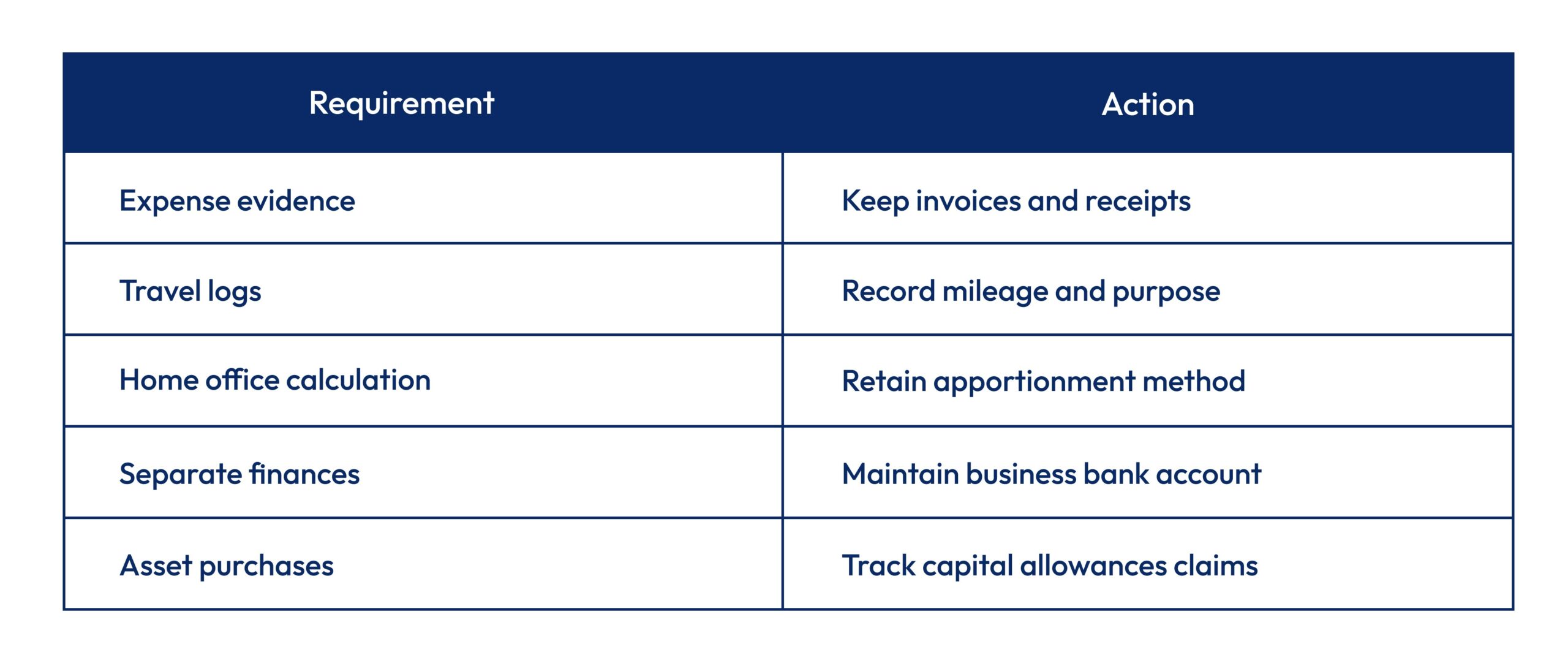
- Keep records: Literal receipts, digital copies, bank statements, or a logbook for mileage.
- Business proportion only: For split-use assets like your phone.
- Exclude commutes: Going from home to a regular workplace? Sorry, that’s on you—unless home is your workplace.
Napkin Math: The Mileage Rate Game
Let’s do a quick napkin calculation. If you rack up 8,000 business miles annually in your car:
- You can claim 45p per mile for those first 10,000 miles, giving you £3,600 tax-deductible.
- After 10,000, it drops to 25p per mile. If you’re racking up more than that, you probably know a shortcut to the M25.
For home offices, HMRC offers a simplified flat rate—from £10 to £26 per month based on the hours you actually work at home. It saves the agony of splitting the utility bill for every lightbulb you use.
Compliance: Not Optional
Let’s make one thing crystal clear: claiming dodgy expenses isn’t a loophole—it’s a spotlight trained on your next HMRC audit. If you’re using the £1,000 trading allowance or trying to sneak in expenses that are mostly personal, expect questions.
“Expense Hub makes this a breeze. Snap receipts, tap to assign categories, and—boom—your expense claim is export-ready for HMRC.”
The platform even cross-checks for anomalies: spending £500 on “stationery” at the local wine shop will raise a little digital eyebrow. So unless you’re hosting a very unusual office party, stick to the rules.
Key Benefits of Using Expense Hub for Managing Business Expenses
By now, you’re probably thinking, “Sure, I can do all this manually.” But I say: “Why spend your life chasing receipts when you could let Expense Hub do the heavy lifting?”
Automated Tracking & Receipt Wrangling
Forget bulging wallets and ink-smeared folders. Expense Hub uses your phone camera to zap receipts into submission, automatically recognises suppliers, splits costs between business and personal usage, and tags them like a pro.
- Automated reminders mean you won’t forget to log a taxi journey or client lunch.
- Smart categorisation means those cryptic £12.36 Amazon purchases get classified correctly every time.
Comprehensive, HMRC-Ready Reporting
Ever tried to compile a year’s worth of expenses into an HMRC report at midnight on 29th January? It’s horrible. Expense Hub fires out compliant export files faster than you can say “tax deductible.” When the auditor calls, you can hand them a digital file they’ll thank you for.
- Real-world impact: According to https://www.spendesk.com/blog/limited-company-expenses/, digital expense tools save hours (sometimes days) of admin time every month.
- One small UK firm cut their tax-prep hours by 20%, dodged a £2,000 misclaim penalty thanks to Expense Hub’s compliance flags, and now sleep soundly during HMRC audit season.
Compliance Alerts & Peace of Mind
Get alerted the moment you try to sneak in an iffy expense. Expense Hub knows the HMRC rulebook inside out and applies it faster than you can type “Is this deductible?” The end result? More valid claims, less risk, and a better night’s sleep for you—and your accountant.
Ready to Conquer Your Business Expenses (and Sleep Easy)?
Here’s the bottom line: allowable business expenses in the UK aren’t just a “nice-to-know”—they’re the backbone of every profitable, compliant business. Knowing exactly what to claim (office costs, travel, salaries), what not to claim (entertainment, fines), and how to handle those “sundry” curveballs, makes the difference between prosperity and panic.
With https://www.gov.uk/expenses-if-youre-self-employed and https://www.axa.co.uk/business-insurance/business-guardian-angel/what-are-allowable-expenses/ backing up every tip, there’s no excuse for letting your hard-earned cash slip through accounting cracks. And with Expense Hub doing the heavy lifting—tracking, categorising, scanning, and even nudging when your records get messy—you can focus on what you do best: running (and growing!) your business.
Stay updated with the latest from HMRC, explore official resources regularly, and treat your expense tracking as a profit tool, not a tedious chore.
Ready for less hassle and more savings? Try Expense Hub today, and turn your expenses into opportunities—minus the audit anxiety.
P.S. If this guide just saved you a bundle, maybe treat yourself. But—sorry!—that pint at the pub still isn’t deductible. Better luck next year.