
Mileage Reimbursement Rates 2025–2026: The Complete Guide for Businesses
- Mileage Reimbursement Rates 2025–2026: The Complete Guide for Businesses
- What Are Mileage Reimbursement Rates?
- Current Mileage Reimbursement Rates: IRS (US) 2025 & 2026
- HMRC Mileage Rates: What UK Businesses Need to Know
- How to Claim Mileage from HMRC: Step-by-Step
- What Drives Changes in Mileage Reimbursement Rates?
- Standard Rate vs. Company Mileage Rate: Which Should You Use?
- Why Accurate Mileage Tracking Matters More Than the Rate
- Using Mileage Rates to Optimise Business Travel Costs
- Why Manual Mileage Reimbursement Is Costing You More Than You Think
- How Expense Hub Makes Mileage Reimbursement Effortless
- Frequently Asked Questions
- Ready to Bring Your Mileage Reimbursement Into 2025 and Beyond?
Picture this: Sarah, a sales manager, slams her trunk shut before her third client meeting of the day. Another long drive. She knows the journey is essential — but she also knows the reimbursement claim sitting between her and that fuel money is anything but simple.
If that sounds familiar, this guide is for you.
Mileage reimbursement is one of those business processes that looks simple on the surface but quietly bleeds time, money, and morale when handled poorly. Whether you’re an employee driving your own car for work or a finance leader trying to keep travel costs under control, understanding the current rates — and having the right tools to track them — is non-negotiable in 2025 and beyond.
This guide covers everything: what mileage reimbursement rates are, the current IRS and HMRC rates, how to claim correctly, and how Expense Hub automates the whole process so your team spends less time on admin and more time on work that matters.
What Are Mileage Reimbursement Rates?
A mileage reimbursement rate is the per-mile (or per-kilometre) amount a company pays an employee when they use their personal vehicle for business travel. It is not a flat allowance — it is a calculated figure designed to cover the real costs of driving: fuel, tyre wear, insurance, maintenance, and vehicle depreciation.
The formula is straightforward:
Miles Driven × Mileage Rate = Reimbursement Owed
Commutes to the office don’t count. But client visits, site inspections, inter-office travel, and business errands do.
Why use a fixed per-mile rate rather than reimbursing exact costs? Because collecting individual receipts for every fuel stop, oil change, and tyre rotation creates administrative chaos — for both employees and finance teams. A standardised rate keeps things clean, compliant, and fair.
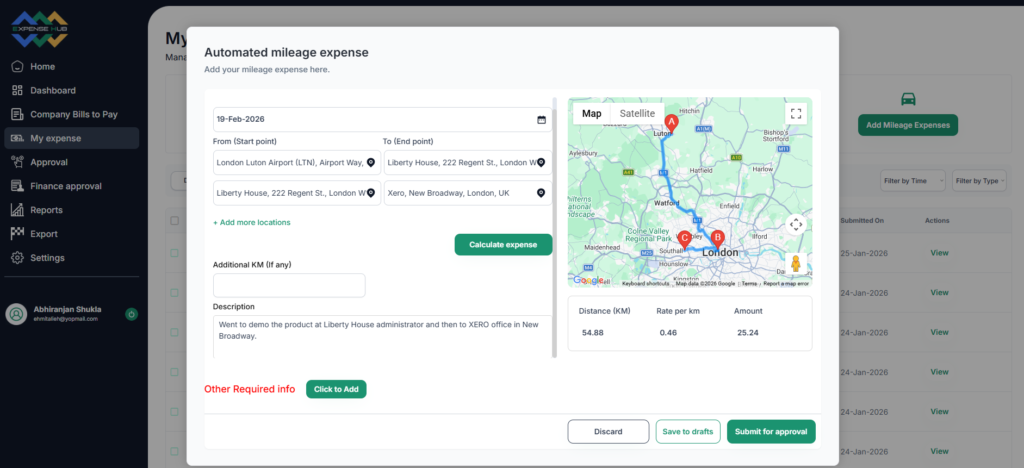
Expense Hub applies the current approved rate automatically when an employee logs a trip, so there is no manual lookup, no outdated figures, and no compliance risk.
Current Mileage Reimbursement Rates: IRS (US) 2025 & 2026
The IRS sets optional standard mileage rates annually, based on a study of fixed and variable vehicle operating costs. These apply to cars, vans, pickups, and panel trucks — regardless of whether they run on petrol, diesel, hybrid, or electricity.
2025 IRS Standard Mileage Rates (Jan 1 – Dec 31, 2025)
| Purpose | Rate per Mile |
|---|---|
| Business use | 70 cents |
| Medical purposes | 21 cents |
| Charitable organisations | 14 cents |
| Moving (active-duty military only) | 21 cents |
Source: IRS Notice 2025-5
2026 IRS Standard Mileage Rates (from Jan 1, 2026)
The IRS announced an increase for 2026, reflecting rising vehicle ownership and operating costs:
| Purpose | Rate per Mile |
|---|---|
| Business use | 72.5 cents |
| Medical purposes | 20.5 cents |
| Charitable organisations | 14 cents |
Source: IRS IR-2025-128
What Does 70 Cents Per Mile Actually Cover?
Let’s do the napkin maths. A field sales rep drives 1,000 business miles in a quarter:
1,000 × $0.70 = $700 in reimbursement
That $700 covers a proportionate share of fuel, maintenance, insurance, and depreciation — not just the petrol. The IRS rate is not arbitrary; it reflects real-world cost data reviewed every year.
Keeping up with annual changes manually is where most businesses slip. Expense Hub stays synced with the latest IRS rates, so your reimbursements are always calculated on the correct figure — even when the rate changes mid-year.
HMRC Mileage Rates: What UK Businesses Need to Know
For UK businesses and employees, HMRC sets Approved Mileage Allowance Payments (AMAP). These are the maximum tax-free amounts you can pay or claim per mile using a personal vehicle for work.
Current HMRC AMAP Rates
| Vehicle | First 10,000 miles | Over 10,000 miles |
|---|---|---|
| Cars and vans | 45p per mile | 25p per mile |
| Motorcycles | 24p per mile | 24p per mile |
| Bicycles | 20p per mile | 20p per mile |
If your employer pays below the AMAP rate, you can claim the shortfall as tax relief directly from HMRC through your Self Assessment return. If they pay above it, the excess is treated as taxable income.
Expense Hub automatically applies HMRC AMAP rates for UK users and flags when an employee’s annual mileage crosses the 10,000-mile threshold — switching to the lower rate without any manual intervention. See our detailed HMRC mileage rate guide for more.
How to Claim Mileage from HMRC: Step-by-Step
If you’re a UK employee or self-employed worker, here is how the HMRC mileage claim process works:
Step 1: Confirm Eligibility
You must be using your own vehicle for a genuine business journey — not a commute to your regular workplace. If you drove to a client site, a temporary workplace, or a business event, you are eligible.
Step 2: Log Every Journey
HMRC expects detailed records for every claim:
- Date of the journey
- Start and end location
- Business purpose
- Miles driven
- Rate applied
- Total claim amount
This is where most people fall short. Paper logs get lost. Spreadsheet estimates drift. With Expense Hub, GPS tracking captures every journey automatically — date, route, distance — and stores it in an audit-ready log.
Step 3: Apply the Correct Rate
Use 45p per mile for the first 10,000 miles and 25p after that. If you carry a fellow employee as a passenger on the same business journey, you can claim an additional 5p per mile per passenger.
Step 4: Submit Your Claim
Employees submit claims through their employer’s expense process. Self-employed individuals include mileage claims in their annual Self Assessment tax return.
Expense Hub generates the claim documentation automatically and can send deadline reminders, so nothing gets missed. Read our guide on what UK small businesses can and can’t claim for a broader overview of allowable expenses.
What Drives Changes in Mileage Reimbursement Rates?
Understanding what moves these rates helps you anticipate changes and plan your travel budget more accurately.
Fuel prices have the most immediate impact. When pump prices spike — as they did sharply in 2022 — the cost-per-mile rises, and rates adjust to keep employees whole.
Vehicle maintenance costs feed into the calculation annually. Parts, labour, and servicing costs all vary and are factored into the IRS’s fixed-and-variable cost study.
Depreciation is often overlooked but always present. Every business mile accelerates wear on a personal vehicle, reducing its resale value. The standard rate accounts for this invisible cost.
Regional variation is less reflected in IRS or HMRC rates (which are national) but matters when companies set their own policies. Driving in central London costs more in time and wear than driving rural routes. Expense Hub allows you to set custom rates by region or team if your company operates across different cost environments. See our expense management software guide for how custom policies work in practice.
Regulatory updates happen each December for the following year. Missing them means you’re reimbursing on the wrong rate — often underpaying employees, which creates compliance and morale issues.
Standard Rate vs. Company Mileage Rate: Which Should You Use?
Many businesses face this decision: use the government-approved standard rate, or set your own company mileage rate?
Using the Standard Rate (IRS or HMRC)
Advantages: Audit-proof, widely understood, easy to communicate, no guesswork.
Disadvantages: May not reflect your company’s specific vehicle fleet, geography, or travel patterns.
Setting Your Own Company Rate
Advantages: Flexibility to go higher (as a perk) or lower (if your fleet economics justify it).
Disadvantages: Rates below the statutory rate can trigger employee dissatisfaction and even legal scrutiny. Rates above it may be considered taxable income in some jurisdictions.
The practical approach: Use the statutory rate as your ceiling and policy baseline. Only deviate if you have a clear, data-backed reason — and communicate it transparently to your team.
Expense Hub lets you toggle between standard rates and custom company rates. When a rate changes, your employees are notified automatically, so there are no surprises on either side.
Why Accurate Mileage Tracking Matters More Than the Rate
Setting the right rate is step one. Actually tracking miles correctly is where most businesses lose money — in both directions.
Overestimation is common when employees log from memory. A trip that was 18 miles gets rounded to 20. Multiply that across a team of 30 field reps over a year, and you’re reimbursing thousands of extra miles that were never driven.
Underestimation happens when employees don’t bother submitting small trips because the paperwork isn’t worth it. Those unclaimed miles add up, and employees quietly absorb costs they shouldn’t.
Audit exposure is real. The IRS and HMRC both require detailed, contemporaneous mileage records. “I estimated based on Google Maps” is not a compliant answer.
Expense Hub’s GPS-integrated tracking solves all three problems simultaneously. Employees tap to start a trip; the app records the route, distance, and timestamp. Claims are generated from actual data, not memory. And every log is audit-ready from day one.
Here’s what that looks like in practice: A regional manager who previously estimated 4,300 miles in a year found his actual GPS-tracked mileage was 3,895 miles. That’s 405 miles of over-reimbursement eliminated — and a cleaner audit trail when his company’s records were reviewed.
For a deeper look at how better tracking improves your overall finance process, see our guide on improving expense and finance process reporting.
Using Mileage Rates to Optimise Business Travel Costs
Smart businesses don’t just set a mileage rate and forget it. They use mileage data as a management tool.
When employees know their mileage is being tracked accurately, they naturally start to question unnecessary trips. Three separate client visits that could be combined into one loop mean one reimbursement claim instead of three. That’s not just cost saving — it’s time efficiency.
Expense Hub’s reporting dashboard surfaces patterns you’d never spot in a spreadsheet. Which team racks up the most business miles? Which routes are being driven repeatedly? Are there opportunities to regroup client visits by geography?
One logistics company using Expense Hub identified that their delivery supervisors were averaging 300 business miles per week — double the sector average. By re-routing delivery zones and coordinating group site visits based on actual mileage data, they reduced weekly reimbursement costs by 20% within a quarter.
Mileage data is business intelligence. Effective travel budget management starts with accurate numbers — and accurate numbers start with automated tracking.
Why Manual Mileage Reimbursement Is Costing You More Than You Think
If your business still relies on paper logs, email submissions, or spreadsheet calculations, you’re paying a hidden tax on every reimbursement cycle.
Calculation errors are almost inevitable. A misplaced decimal or incorrect rate applied to 50 trips per month compounds quickly.
Processing delays hurt employee trust. When a field rep waits four to six weeks to be reimbursed for fuel they paid out of pocket, it affects morale — and retention.
Audit exposure grows with every undocumented trip. If records can’t be produced on demand, the business absorbs the liability.
Finance team overhead is significant. Manually processing mileage claims, chasing missing information, and cross-checking rates is low-value work that pulls skilled people away from strategic tasks.
Expense Hub eliminates all of this. GPS tracking means logs are automatic. Rate compliance is built in. Claims are reviewed and approved digitally, and reimbursements are processed faster. One CFO at a national distribution company reported that switching to Expense Hub cut reimbursement processing time by 80% — and removed the need for Finance to chase the sales team every quarter.
How Expense Hub Makes Mileage Reimbursement Effortless
Here is what the Expense Hub mileage workflow looks like in practice:
- Employee opens the app and taps to start a business journey.
- GPS logs the route automatically — distance, time, and location.
- The app applies the correct rate — IRS, HMRC AMAP, or your custom company rate.
- A claim is generated with all required fields pre-populated.
- The manager reviews and approves digitally, with full audit trail attached.
- Finance processes the reimbursement — no chasing, no missing data.
For UK users, Expense Hub also flags the 10,000-mile AMAP threshold, applies the correct rate automatically, and generates HMRC-compliant documentation. For US users, rates update in line with IRS announcements.
Explore how this fits into a broader expense management software solution and see the complete guide to mileage expense management in 2025.
Frequently Asked Questions
What is the IRS mileage rate for 2026?
The IRS standard business mileage rate for 2026 is 72.5 cents per mile, up from 70 cents in 2025. The charitable rate remains at 14 cents per mile.
What is the HMRC mileage rate for cars in the UK?
HMRC’s Approved Mileage Allowance Payment (AMAP) rate for cars and vans is 45p per mile for the first 10,000 business miles and 25p per mile thereafter.
Can I set a mileage rate higher than the IRS standard?
Yes. You can reimburse above the IRS rate, but amounts above the standard rate are generally treated as taxable income for the employee. Most businesses use the IRS rate as their ceiling.
Does the mileage rate apply to electric vehicles?
Yes. IRS and HMRC mileage rates apply to all vehicles — petrol, diesel, hybrid, and fully electric.
What records does HMRC require for a mileage claim?
HMRC expects the date, start and end points, business purpose, miles driven, rate applied, and total amount claimed for every journey. Expense Hub captures and stores all of this automatically.
How often do IRS mileage rates change?
The IRS reviews rates annually and announces the following year’s rates each December. In periods of significant fuel price movement, a mid-year adjustment is also possible.
Ready to Bring Your Mileage Reimbursement Into 2025 and Beyond?
Mileage reimbursement done right protects your employees, satisfies auditors, and gives your finance team clean data to work with. Done poorly, it leaks money, creates disputes, and turns a simple process into a quarterly headache.
The rates are set. The rules are clear. The only variable is whether you track and apply them accurately.
Expense Hub automates the entire process — from GPS-logged trips to compliant claims to approved reimbursements — so your team spends zero time on mileage admin and every mile is accounted for.
Get started with Expense Hub today and make mileage the one expense process that runs itself.
Related Reading: