
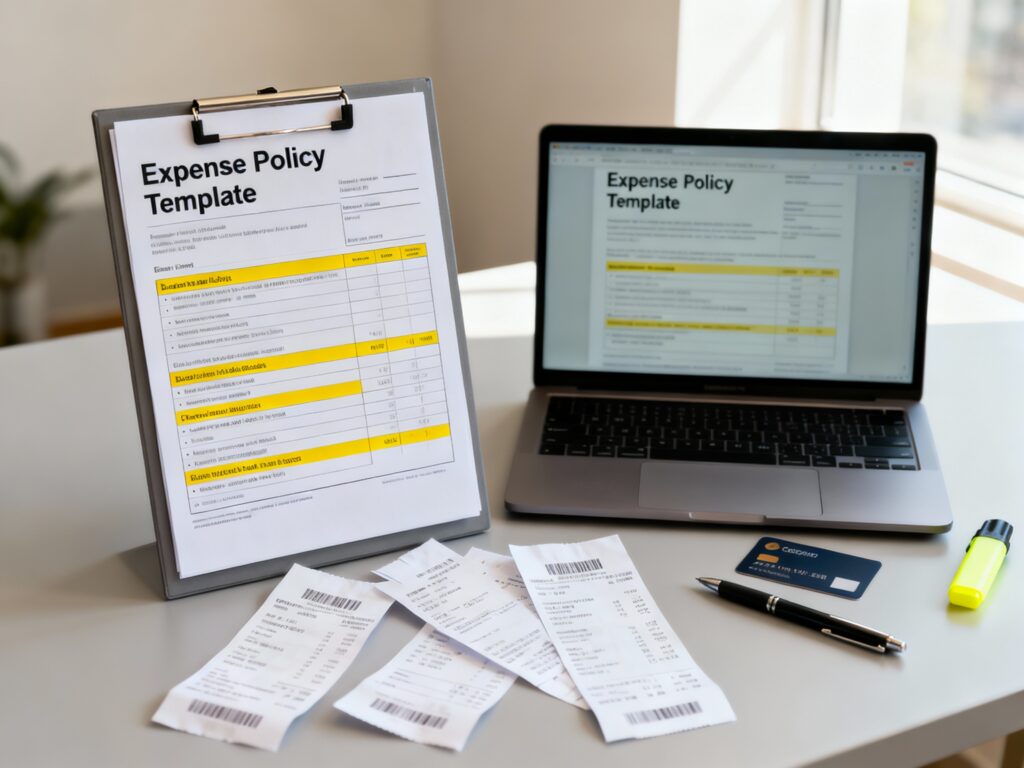
The Essential Guide to Crafting an Effective Expense Policy Template
Sit back and picture this: your accountant is frantically waving a stack of crumpled receipts from last month’s business trip to Cincinnati, muttering something about “policy violations” while your team argues over whether “artisan dog treats” can count as a client gift. If this sounds familiar, your business desperately needs an expense policy template—or, more frankly, a lifeboat for your financial sanity.
But wait, it gets better: what if I told you there’s a way to make all the confusion, lost receipts, and passive-aggressive emails vanish? Enter Expense Hub, the tool smart businesses are using to escape the Wild West of expense management. Whether you run a law firm or a lemonade stand, this blog is your map—showing you what an effective expense policy looks like, why you need it, and, crucially, how the right tech (ahem, Expense Hub) can make the entire process laughably easy. Learn more about managing business expenses effectively with insights from our https://blog.expensehub.io/expense-management-for-startups-guide.
Let’s break the “expense policy” conundrum down like a fifth-grade math problem—and yes, we’ll use stories and some napkin math to keep things light.
What Is an Expense Policy Template? (And Why Does Every Business Need One?)
Before we dive into policies, let’s get one thing straight. An expense policy template is not just paperwork for paperwork’s sake. It’s a formal document—think of it as the company’s recipe card for reimbursing employees when they buy stuff for work. It answers questions like:
- What can I claim?
- How do I claim it?
- How quickly will I get paid back?
- Can I finally buy that monogrammed stapler? (Spoiler: probably not.)
But it’s more than just a list of dos and don’ts. At its core, a stellar expense policy template creates structure—the same way goal posts define a soccer field. Without structure, things quickly dissolve into chaos, late reimbursements, and eye-watering mistakes on the company credit card. According to Bill.com, a well-crafted template ensures streamlined financial management, minimizes errors, and keeps your business compliant with regulations. Explore how effective https://blog.expensehub.io/expense-management-software-uk-finances can simplify financial workflows and ensure compliance.
And here’s some extra credit from Indeed: a good template boosts transparency, keeping employees and managers on the same page—and out of each other’s inboxes.
Don’t believe it’s a big deal? Navan’s research shows that murky, non-standard expense practices are a leading cause of employee frustration and late payments (read their findings https://navan.com/blog/free-expense-policy-template-sample-download). That’s where technology steps in.
Enter Expense Hub: Your Template’s Best Friend
Admit it—you’d rather wrestle a raccoon than build another spreadsheet from scratch. That’s why Expense Hub exists. Think of it as the customizable “brain” behind any policy: it gives you templates tailored for your industry, lets you tweak what you need, and handles all the boring (but essential) bits. Now you can stop arguing about Starbucks receipts and focus on what matters—like growing your company. Dive deeper into how https://blog.expensehub.io/unlocking-efficiency-expense-management-software can transform your financial processes.
Expense Hub doesn’t just spit out a generic template, either. Whether you’re in construction or consulting, it serves up variants that match your business language, spending patterns, and reporting needs. That means no more “one-size-fits-none” policies.
The Real Benefits of an Expense Policy Template
Let’s get granular—because platitudes don’t pay the bills.
Ensuring Consistency and Fairness
Imagine if Monopoly let certain players collect $300 for passing Go, while the rest got just $100. Mutiny! That’s what happens in companies where expense guidelines are unclear or unevenly enforced.
A standardized expense policy template (say it three times fast) applies the same rules to everyone. This isn’t just about reducing HR headaches—though that’s a nice bonus. It’s about fairness. Employees know the rules, management knows the rules, and there’s no more ambiguity about whether sushi Tuesday is acceptable or a financial faux pas. For those interested in delving deeper into policy compliance, visit our blog on https://blog.expensehub.io/understanding-compliance-in-expense-management.
As pointed out by https://www.bill.com/business-templates/expense-policy, standardization slashes the number of gray-area disputes to near zero. Everyone from interns to executives can see which expenses are green-lit and which are a hard no. This means more trust, less resentment, and a predictable reimbursement process.
Promoting Clarity, Reducing Conflict
It’s not just about saying “yes” or “no”—it’s about making those answers obvious. The https://navan.com/blog/free-expense-policy-template-sample-download highlights how a precise policy can cut down on after-the-fact arguments (or, worse, creative accounting). When your policy tells everyone exactly what counts as a business expense, you aren’t just making accountants smile. You’re helping the whole organization breathe easier.
Expense Hub Levels Up Transparency
Let’s get practical. You build the best policy on earth, but if tracking claims is like searching for Bigfoot, nobody’s happy. Enter Expense Hub’s real-time tracking tools, which is elaborated further in our https://blog.expensehub.io/maximizing-travel-expense-management-tool:
- Instant notifications let employees see where their claim is in the approval chain—no more “Did you get my email?” loop.
- Dashboards organize everything, so finance teams can spot outliers before they blow the quarterly budget.
- Digital records keep managers and staff accountable: every approval, every receipt, every note logged, all in one central spot.
Expense Hub isn’t just a tool. It’s the referee, scoreboard, and instant replay booth ensuring fair play, every day.
Anatomy of a Great Expense Policy Template: All the Parts You Need
A patchwork policy built on gut-feelings and improv? Pass. Let’s do this right.
1. Purpose and Scope
Start strong: Why does this policy exist and who does it cover? For example:
“This expense policy outlines the guidelines for all employees traveling on company business or incurring job-related expenditures. It ensures reimbursable expenses are fair, justified, and aligned with our budget.”
That means everyone knows their eligibility from day one. No fine print, no “read between the lines” drama.
2. Expense Categories and Eligibility
This is your master list of what counts:
- Travel: Flights, taxis, and lodging (fancy hotel rooms not included).
- Meals: Business dinners, yes. Midnight room service caviar? Sorry.
- Supplies: Office essentials, not your personal espresso machine.
This list ensures no one tries to sneak last weekend’s bar tab through as a “team-building exercise.” The https://resources.workable.com/employee-expense-company-policy recommends being ultra-specific. The more examples you give, the less likely you’ll see “miscellaneous” abused. For more detailed insights, check out our guide on https://blog.expensehub.io/sundry-small-business-expenses-uk-2025-what-you-can-and-cant-claim-the-complete-guide/.
3. Approval Levels and Workflow
How does an expense travel from employee to reimbursement? Here’s where clarity pays off. Maybe it looks like:
- Employee submits expense report with receipts.
- Manager reviews and approves (or rejects).
- Finance makes the final call.
Mapping this flow helps both new hires and veterans avoid delays and frustration. According to https://www.indeed.com/career-advice/career-development/expenses-policy-template, having this process in writing reduces bottlenecks, blame games, and lost reimbursement requests.
4. Reimbursement Process
This answers, How and when do I get paid back? Make it crystal-clear:
- Submission deadline: “Expenses must be submitted within 30 days of purchase.”
- Required documentation: “Receipts are required for all transactions above $25.”
- Payment timeline: “Approved reimbursements are paid out within 14 business days.”
When you spell out timelines, everyone knows the drill.
5. Limits and Restrictions
Just because Megan had a great dinner doesn’t mean the company can foot her $120 wine bill. Set concrete caps:
- $50/day limit on meals.
- Airfare must be booked at least 14 days in advance.
- Pre-approval needed for any single expense over $200.
Bill.com recommends adjusting these thresholds by department and job function—but always make the logic transparent.
How Expense Hub Makes This Easy
All well and good, but writing this from scratch can feel like building IKEA furniture without instructions. With Expense Hub, you don’t start from a blank doc. The app walks you through each critical category with best-in-class guidance (backed by https://www.bill.com/business-templates/expense-policy), so you never miss a vital clause. Customization lets you add or hide sections based on your industry’s quirks. If you’re interested in the role of automation, our article on https://blog.expensehub.io/the-role-of-automation-in-the-modern-financial-analyst-toolkit provides further context.
TL;DR: Expense Hub gives your template a backbone and a personal touch.
Nailing the Expense Approval Process (Without Losing Your Mind)
Let’s talk about the fabled expense approval process—the gauntlet every claim must run. Poorly designed, it feels like passing Go in Monopoly—too slow, too full of surprises, and everyone fights over the banker.
The Classic Workflow
Here’s how winning companies run the show:
- Submission: Employees send in claims, digital receipts and all.
- Manager Review: Direct supervisors check for policy compliance. Think of it as “quality control for spending.”
- Finance Team Green-Light: The final review. If it passes, money hits the employee’s account. If not, a swift (and clear!) rejection with actionable feedback.
https://resources.workable.com/employee-expense-company-policy and https://www.concur.com/blog/article/expense-policy-template-you-need-to-be-ready-for-change agree: the smoother your workflow, the less chance for unauthorized claims to sneak through or legit ones to get delayed.
Where Expense Hub Shines
Now picture what happens if you put this entire process on autopilot. That’s Expense Hub’s magic—its automated workflows mean:
- The right manager is auto-tagged for every claim (no more “Whose department is this?” emails).
- Expense claims flagged as high risk (say, suspiciously high dinners) are routed with extra scrutiny. No favoritism.
- Real-time dashboards track every pending and approved request.
Want a deeper dive? Check out Efficient Expense Management with Automated Workflows for a breakdown.
Napkin math: If your finance team spends 10 minutes on each of 100 expense reports per month, that’s 1,000 minutes — almost 17 hours. Automated approvals could cut this by 50%. Not bad for something that pays for itself.
Pro Tips for Writing an Effective Expense Policy Template
Alright, you get it. But how do you actually write the thing so that it works in the real world—not just in theory?
Speak Human, Not Lawyer
Write it so your newest intern—and your most seasoned VP—can read and understand in under five minutes. As https://www.indeed.com/career-advice/career-development/expenses-policy-template notes: clarity always wins the day. Bullets, bold headers, and real examples (“If you travel for a conference, you can claim up to $200/night for lodging”) beat legalese every time. For a comprehensive take on optimizing the financial aspects of policy writing, see https://blog.expensehub.io/mastering-expense-management-a-finance-manager-guide.
Simplicity ≠ Weakness
The best policies are clear, not complicated. Don’t try to predict every scenario. Set guidelines, explain the “why,” and define a path for exceptions. This avoids loopholes that get exploited (intentionally or not).
Stakeholder Buy-In: Not Just for Show
Invite feedback from all corners—HR, finance, IT, and, yes, even the road warriors who rack up miles. You’ll spot blind spots and gain instant credibility when policy changes roll out.
https://floatfinancial.com/free-expense-policy-template/ encourages companies to treat policies as living documents. If marketing spends heavily on client lunches, should your daily meal cap reflect reality? Or risk having everyone file “miscellaneous” every month?
Avoid These Common Pitfalls
- Vague terms (e.g., “reasonable expenses” without examples).
- Overlooked updates—If you haven’t touched your policy in two years, you’re basically using carbon paper.
- Too many hoops—Approvals shouldn’t require a PhD in office politics.
As the https://navan.com/blog/free-expense-policy-template-sample-download warns, ambiguous or outdated policies lead to eye-rolling, rule-breaking, and resentment.
How Expense Hub Helps You Avoid the Bear Traps
Expense Hub isn’t just slick software—it’s a GPS for your drafting process:
- In-line policy suggestions and “did you mean?” prompts.
- One-click update reminders when business rules or regulations change.
- Access to expert review support—real humans to sanity-check your draft.
Here’s a great read to bolster your policy wisdom: https://externalresource.com.
From Drama to Discipline: Real-World Success Stories
Sometimes the proof is in the pudding—or, in this case, the expense reports. Let’s look at how real companies have flipped the script.
Case Study 1: Ace Recruitment Inc.
Before implementing an expense policy template, Ace Recreuitment’s finance team played detective each payday, reconstructing coffee receipts and reconciling mystery Uber charges. After standardizing with Expense Hub:
- Processing time for reimbursements dropped 40%.
- Employee disputes over denied claims? Down to zero.
- CFO’s blood pressure? Normal range.
Discover how such transformations are possible by reading about https://blog.expensehub.io/harness-expense-report-software.
Case Study 2: Marketing Agency – Ayyeah
This agency had a “loosey-goosey” system—everyone guessed what was covered. Result? Two employees submitted nearly $800 in duplicate claims. After switching to Expense Hub, they set daily category limits, required digital receipts, and plugged into their existing payroll systems. In month one, they caught a $450+ overage that would’ve slipped by before.
But don’t take it from me—see Client Success Stories with Expense Hub for even more tales of sanity restored.
Expense Hub: The Ultimate Compliance Enabler
You can set the world’s clearest rules, but someone somewhere will try to expense “motivational beach trip” as an innovation offsite. That’s where tools like Expense Hub move from “nice-to-have” to “must-have.”
Real-Time Compliance Tracking
Expense Hub logs every policy violation and soft nudge sent to employees (“Remind Megan: $60 lobster bisque isn’t reimbursable”). Built-in compliance dashboards let you audit spending patterns, identify rule-breakers gently (or not), and keep tax season drama-free. To see more about streamlining reporting, visit https://blog.expensehub.io/improve-expense-finance-process-reporting.
Audit-Ready Documentation
Need to survive an IRS audit? With Expense Hub, every claim, note, and receipt is securely stored, timestamped, and tied to the specific policy it followed (or broke). No more tracking down hand-signed napkin notes from six months ago.
Plug-and-Play Integrations
Even the best template is just one page in your business’s operating playbook. Expense Hub syncs effortlessly with accounting systems like QuickBooks and ERP suites, so every policy rule gets enforced where it matters most—at the ledger. One click, total oversight.
Building Accountability and Culture
Here’s a bonus you can’t miss: when teams see a fair, transparent system working day in and day out, people stop gaming the rules and start following them. Suddenly, “policy” isn’t a dirty word—it’s the backbone of your financial culture.
Why Wait? Take Control of Your Expense Policy (and Your Sanity)
Let’s recap how you pull all this together:
- A smart, well-written expense policy template lays the foundation for financial discipline, trust, and clarity. It turns chaos into calm.
- Expense Hub takes the legwork out of drafting, updating, tracking, and enforcing your policies—no tech degree required.
- Real companies are saving hours, reducing errors, and boosting compliance by pairing smart templates with smarter tech. The result? Less time policing expenses. More time building your business.
If you’re not using a streamlined system, you’re not just wasting money—you’re missing out on peace of mind (and a whole lot of time you could spend on, well, literally anything else).
Ready to Master Your Expenses and Breathe Easier?
If reading this blog gave you even a tiny sigh of relief, good news: Expense Hub delivers the full exhale.
Here’s your next step:
- Sign up for a free demo or trial of Expense Hub now.
- Select from proven, industry-tailored expense policy templates or build your own with expert guidance.
- Test-drive automated approval workflows, real-time compliance dashboards, and seamless integrations—all risk-free.
Stop playing expense report roulette. Draft your policy, automate your process, and finally spend less time chasing receipts and more time running your business.
Your future self—and your entire finance team—will thank you.
Pro-tip: Still wary? Contact our experts for a policy review or join our next webinar on mastering expense policy compliance with Expense Hub.