
- Understanding Allowable Business Expenses in the UK: A Comprehensive Guide
- Why Understanding Allowable Business Expenses in the UK Can Make or Break Your Business
- What Are Allowable Business Expenses in the UK?
- Common Allowable Expenses: The Main Categories (And How To Nail Them)
- Expense Hub: The Go-To for Stress-Free Record-Keeping
- What Happens When You Claim Non-Deductible Expenses? (Spoiler: Nothing Good.)
- Sundry Expenses: The Oddballs of Accounting (And How To Tame Them)
- What Expenses Can I Claim With HMRC? (And How Do You Actually Do It?)
- Let’s Get Techy: Leveraging Technology to Manage Expenses (and Your Sanity)
- Ready to Transform Your Business Expense Management?
Understanding Allowable Business Expenses in the UK: A Comprehensive Guide
Why Understanding Allowable Business Expenses in the UK Can Make or Break Your Business
Let’s be honest. Most people start a business because they’ve got a big idea, a hunger for freedom, maybe even a passion for coffee-shop wifi. Nobody—literally nobody—starts a business for the joy of categorizing receipts. Yet here we are, drowning in invoices and HMRC lingo, all because “business expenses” lurk behind the corner of profitability like a shadowy tax ninja.
Understanding allowable business expenses in the UK is crucial for financial success. Imagine you could wave a magic wand over your expenses and—poof—watch your taxable profits shrink to a manageable size. That’s what knowing your deductible from your dodgy gets you. But misstep here, and you could find yourself starring in an all-expenses-paid audit (minus the fun cocktails).
So why does this stuff matter? Proper categorization of business expenses is the unsung hero of not just accurate tax reporting, but also financial health. It’s the difference between running a lean, mean, tax-efficient machine…and standing in a queue, patiently explaining your shoe collection to an HMRC inspector.
Here’s where Expense Hub enters stage left, cape fluttering. Expense Hub isn’t just another shiny software; it’s your secret sidekick for tracking, categorizing, and optimizing every penny flowing out of your business (and then, quite possibly, back into it.) Disorganized spreadsheets and end-of-year panic attacks are officially a thing of the past. With Expense Hub, your expenses get sorted, flagged, and filed—effortlessly.
But before we let the robots do all the work, you need to know the rules. Like a savvy detective, you must separate the “allowable” from the “absolutely-nope.” Confusing the two? That’s a shortcut to penalty city. So let’s dig in. We’ll not only clarify what you can and can’t claim but also show—with the help of technology—how to future-proof your books, sidestep common traps, and keep more cash inside your business, where it belongs.
What Are Allowable Business Expenses in the UK?
The Basics: Defining Allowable Business Expenses
Let’s talk definitions—with the kind of clarity you only get from a friend who isn’t billing by the hour. Allowable business expenses in the UK are those that can be deducted from your business’s gross income to reduce the total taxable profit. In other words, for every £1 you can legitimately claim, that’s one less pound being eyed up by the tax office.
Think of it like this: If you make £100,000 in sales, but you had to spend £30,000 keeping the ship afloat (on things like paper, payroll, and petrol), you’re only taxed on the remaining £70,000. You just reduced your “Here’s what I owe” napkin math, all because you knew what was allowed.
But—there’s a catch. HMRC isn’t about to let you write off your personal Netflix subscription as “essential business research.” The rules are clear: any cost must be wholly and exclusively for business use. Translation: If the expense also helps you finally finish Breaking Bad, it probably doesn’t count.
For more insights on what you can claim, check out https://blog.expensehub.io/sundry-small-business-expenses-uk-2025-what-you-can-and-cant-claim-the-complete-guide/.
Real-World Examples (With No Nonsense)
Let’s demystify with some everyday, “oh, that’s me!” examples:
- Office supplies: Paper, printer ink, and those highlighters you never actually use—all allowable.
- Staff salaries: If you pay employees, their wages count.
- Business travel: Train tickets to see a client in Manchester? Allowable. Your week in Marbella “for inspiration”? Not so much.
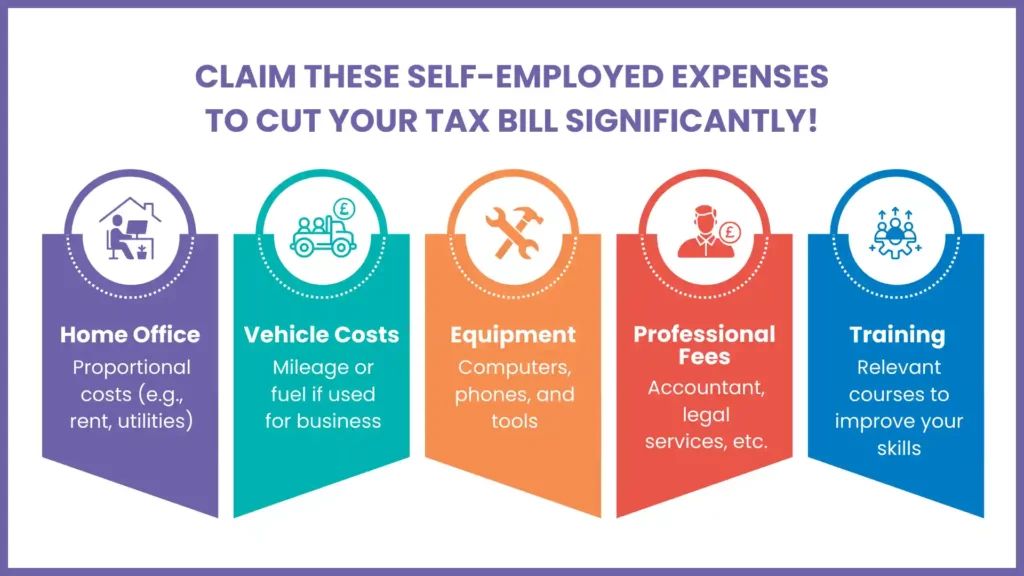
- Professional fees: Accountant fees, legal advice, and yes, even certain software subscriptions (hello, Expense Hub).
For a full list, HMRC lays it out in detail. They’re surprisingly helpful when it comes to https://www.gov.uk/expenses-if-youre-self-employed.
When it comes to tracking what’s allowable, the messier your methods, the bigger the headache. Let’s face it: “pile of receipts in a shoe box” is not a strategy, it’s a write-off in itself.
Modern Solutions: How Expense Hub Makes It Effortless
This is where I wave the magic wand called Expense Hub. Imagine a dashboard that reads your mind (okay, just your bank statements), tags each transaction, and files it to the right categories—automatically. Just like that, you’re no longer spending Sunday afternoons with a calculator and a cold cup of coffee trying to remember what “business lunch” really meant back in March.
Want to go deeper on how technology is cleaning up accounting chaos? Sign up to Expense hub today.
Common Allowable Expenses: The Main Categories (And How To Nail Them)
There’s a difference between knowing you can deduct something and actually doing it the right way. Let’s break expenses into bite-sized chunks, with examples, stories, and the occasional napkin calculation.
1. Travel Expenses
Say you’re a freelance photographer hopping on a train to shoot portraits for a new client. Train fare? Allowable. Taxi from station to venue? Allowable. The croissant you scarfed en route? Sorry, that one’s for the personal treat column.
HMRC’s travel rules are strict: only journeys “wholly and exclusively” for business count. Commuting from home to your regular office? No dice. Taking a train across town for a one-off client pitch? Go for it.
Example:
Jack spends £400 a month zipping between client sites and conferences. That’s potentially £4,800 a year in deductible travel costs. With Expense Hub, Jack auto-tags Uber rides and trains so nothing gets lost in the mix. (No more “was that for Amy’s wedding or the sales meeting?”)
For more on managing travel expenses, see https://blog.expensehub.io/tips-to-control-travel-budgets-with-effective-expense-management/.
2. Office Rent and Utilities
Renting a tiny office above the bakery (with the world’s best cinnamon rolls)? Allowable expense right there. Add on water, gas, electricity, and even business rates—they all qualify.
If you work from home, you can apportion costs—even down to a percentage of your broadband—provided you use it for business. But don’t get greedy; HMRC has calculators and they aren’t afraid to use them.
3. Employee Salaries and Subcontractors
Employees don’t just want a pat on the back; they want a payslip. Salaries, bonuses, National Insurance contributions, and, yes, even pension payments are all fair game for deduction.
Take Lin, who pays herself and her two assistants a combined £60,000. That’s £60k HMRC knows she’s not just pocketing; it goes right on the business expense sheet.
For a closer look at optimizing staff cost management, see https://blog.expensehub.io/mastering-business-expenses-management.
4. Utilities and Communications
Bills don’t pay themselves. Neither does internet, phone, or, for some businesses, postage and courier fees. Every printer page, each packet of novelty business cards, and the line rental tying your office to the 21st century? All allowable.
A Word on HMRC Guidelines (And Why It Matters)
Here’s your golden rule: every expense must be recorded accurately, with receipts or digital records attached and legible. No, “lost in the car glove box” is not a recognized filing system.
Follow https://www.gov.uk/expenses-if-youre-self-employed for clarity. And if “filling out forms” feels like medieval torture, here’s your savior—Expense Hub. Log expenses on the go, snap receipts, and never type the same thing twice. When tax season comes, your accountant will kiss your ring.
Expense Hub: The Go-To for Stress-Free Record-Keeping
Expense Hub’s mission: make sure every expense is coded, captured, and compliant. That means:
- Automated expense categorization: No more “miscellaneous” black holes.
- Real-time reporting: For when HMRC (or, heaven help you, an investor) wants the numbers now.
- Receipt storage: Because shoeboxes are for shoes, not legal documents.
Want details from the taxman himself? Here’s https://www.gov.uk/expenses-if-youre-self-employed.
What Happens When You Claim Non-Deductible Expenses? (Spoiler: Nothing Good.)
What Are Non-Deductible Expenses in the UK?
Let’s switch gears. Not all spending leads to tax savings. Some things—no matter how passionately you feel about their corporate value—simply aren’t deductible.
Classic Examples:
- Personal expenses disguised as business: That’s your weekend spa trip. Doesn’t matter how well you networked in the sauna.
- Fines and penalties: Speeding tickets (don’t blame the Sat Nav!) and late filing penalties are out.
- Client entertainment: Taking a client to a football match to “discuss synergies”? Sadly, that one’s for the memories, not the tax return.
Claiming these is like waving a red flag at HMRC—and guessing they’ll be impressed by your boldness. Spoiler: They won’t.
For more about what not to claim, read https://blog.expensehub.io/what-you-can-cant-claim-expenses-uk.
The (Very Real) Consequences
Get caught pushing your luck and you’ll find yourself paying back taxes plus penalties, plus interest, plus a few awkward meetings. Deliberate miscategorization? HMRC can go nuclear and launch a full-on investigation. Suddenly, you’re famous… for all the wrong reasons.
How Expense Hub Nips Errors in the Bud
Expense Hub is built to idiot-proof your expense categories. Algorithms flag dubious claims (“Hawaiian Shirt: ‘office uniform’?”) and prompt you to clarify anything sketchy. It’s pain relief for the honest but scatterbrained business owner.
Want a crash course on what-not-to-do? Rea. Trust me, it’s better to learn from other people’s mistakes than make them yourself.
Sundry Expenses: The Oddballs of Accounting (And How To Tame Them)
What on Earth Are Sundry Expenses?
Imagine a category reserved for the weird and wonderful/unexpected. Sundry expenses are those “small, irregular” costs that don’t fit neatly into main accounts: newspaper ads, one-off repairs, emergency courier trips.
But here’s the thing: sundry isn’t code for “just shove it here.” You still need details—date, amount, purpose—and justification that it’s a business expense.
HMRC’s Take on Sundry Claims
HMRC wants clarity. A “sundry” line with £12,000 in “miscellaneous” will raise eyebrows faster than you can say “tax investigation.” Document everything, even the little stuff.
For instance, last-minute repairs on your coffee machine before a client meet? That counts (filed as “repairs and maintenance”). But a spontaneous cake purchase probably won’t. (Sorry, cake fans.)
For a detailed exploration of sundry expenses, visit https://blog.expensehub.io/sundry-small-business-expenses-uk-2025-what-you-can-and-cant-claim-the-complete-guide/.
Manage Sundries and Sleep at Night: Expense Hub’s Approach
Expense Hub lets you tag oddball items, attach explanations, and even store photos of receipts. When it’s time to justify claims, you’ll have a digital paper trail for every pound. The days of “it’s just a tenner, who’ll notice?” are over.
What Expenses Can I Claim With HMRC? (And How Do You Actually Do It?)
A Step-By-Step Guide for Claiming Business Expenses
Let’s get to the action: what expenses can I claim HMRC (yep, keyword magic), and how do you ensure nothing falls through the cracks?
List Every Possible Allowable Expense
– Travel, rent, utilities, professional fees, salaries, stationery, insurance, bank charges, advertising, and sundries.
– Pro tip: Don’t forget software subscriptions—especially if you’re running streamlined expense management through Expense Hub.Collect and Store Documentation
– Every claimable expense needs proof—a digital receipt, a scanned invoice, or at the very least, a bank statement highlight. Loose verbal agreements don’t count.Record It Immediately
– The best time to record an expense? Right now, before Lunch-You eats the receipt. With Expense Hub’s mobile upload, you can photograph, tag, and archive receipts seconds after a transaction.Categorize Accurately
– Use precise categories that match HMRC’s terminology (you’ll thank yourself later). Expense Hub’s automation keeps you from falling into the “miscellaneous” black hole.Submit Claims with Your Tax Return
– Allowable expenses are filed as part of your annual Self Assessment or Corporation Tax return. Expense Hub can generate the needed summaries so it’s less “tax pain,” and more “button click.”
Stay Ahead: Recent Updates in HMRC Expense Policies
Tax rules don’t sit still—they shift like British weather. Recent https://www.gov.uk/expenses-if-youre-self-employed have clarified allowances for working-from-home expenses, simplified mileage rates, and even digital record-keeping requirements. Ignoring these? That’s how good businesses turn into cautionary tales.
Don’t have time to stalk government websites? Expense Hub bakes in the newest HMRC criteria, updating categories as policies change. In short: compliance, on autopilot.
Let’s Get Techy: Leveraging Technology to Manage Expenses (and Your Sanity)
The Role of Financial Technology: More Than Just Buzzwords
Ask yourself—how much time do you waste squinting at receipts or playing “Where’s Waldo?” with digital statements?
With technology, you set it and forget it. Machine learning doesn’t get bored or put receipts in the wash—it sorts, categorizes, and flags errors 24/7. Financial technology isn’t the future, it’s now—and it separates the organized from the perpetually frazzled.
Why Expense Hub? Real Features, Real Relief
- Seamless integration: Connect your business bank accounts, credit cards, and even e-wallets to pull in transactions automagically.
- User-friendly interface: Grandma could use it. (If grandma ran a digital marketing agency.)
- Custom tagging: From “client travel” to “emergency snacks,” create categories that make sense for your business.
- Instant reports: Tax-time? One click and you’ve got everything your accountant (or HMRC) could ask for.
Story Time: Sarah’s Success with Expense Hub
Sarah runs a boutique social media agency out of Brighton—and until recently, her expense system was a stack of envelopes marked “URGENT!” In a panic one October, she signed up for Expense Hub.
Result:
– No more lost receipts.
– Automated categories caught a £3,200 travel cost she almost forgot.
– Her accountant sent a “thank you” card instead of a panic email.
Moral of the story? Financial technology pays dividends—sometimes literally.
Ready to Transform Your Business Expense Management?
We’ve covered a lot—from allowable business expenses in the UK, to what expenses you can claim with HMRC, to how Expense Hub saves you time, money, and a few grey hairs. Here’s what’s next:
- Understanding what counts (and what doesn’t) is non-negotiable for success.
- Organizing as you go (not at year-end panic time) saves hours and thousands.
- Using Expense Hub makes record-keeping so painless, you’ll wonder why you ever tried to “wing it.”
Don’t let receipts rule your life—or your tax bill. Upgrade your expense management today.
Try Expense Hub—free demo, risk free—right now: ExpenseHub
For the definitive official word, see:
https://www.gov.uk/expenses-if-youre-self-employed