
- Mastering Your Spend Management Strategy: Innovative Approaches for Today’s Businesses
- What Exactly *Is* a Spend Management Strategy — and Why Should You Care?
- Why a Spend Management Strategy Is Your Financial Bodyguard
- Petty Cash Management Alternatives: Ditching Dinosaurs for Digital Dollars
- Company Spending Limits: Putting a Firm Yet Friendly Hand on the Wallet
- Employee Spending Card Controls: Turning Loose Cannons Into Accountable Heroes
- Controlling Maverick Spend: Herding the Wild Ponies of Business Expenses
- Ready to Take Control of Your Finances? Here’s Your Next Step
Mastering Your Spend Management Strategy: Innovative Approaches for Today’s Businesses
What Exactly *Is* a Spend Management Strategy — and Why Should You Care?
Let’s be blunt: spend management strategy isn’t the kind of phrase that gets your heart racing. I get it. But it is the difference between a business spending like a wise monk or burning cash like a caffeinated pirate. A rock-solid spend management strategy is how today’s successful companies track, control, and — here’s the kicker — optimize every penny that sails through their accounts. The endgame? Every dollar aligns with budgets, corporate policies, and, most importantly, the actual business objectives that drive growth, not gray hairs (read up on why this matters at https://coastpay.com/blog/spend-management/ and https://www.ivalua.com/blog/business-spend-management/).
Think of it as the GPS for your company’s financial road trip. Without it, you’re not just lost, you’re also running out of gas, coffee, and maybe road-trip snacks three towns too early.
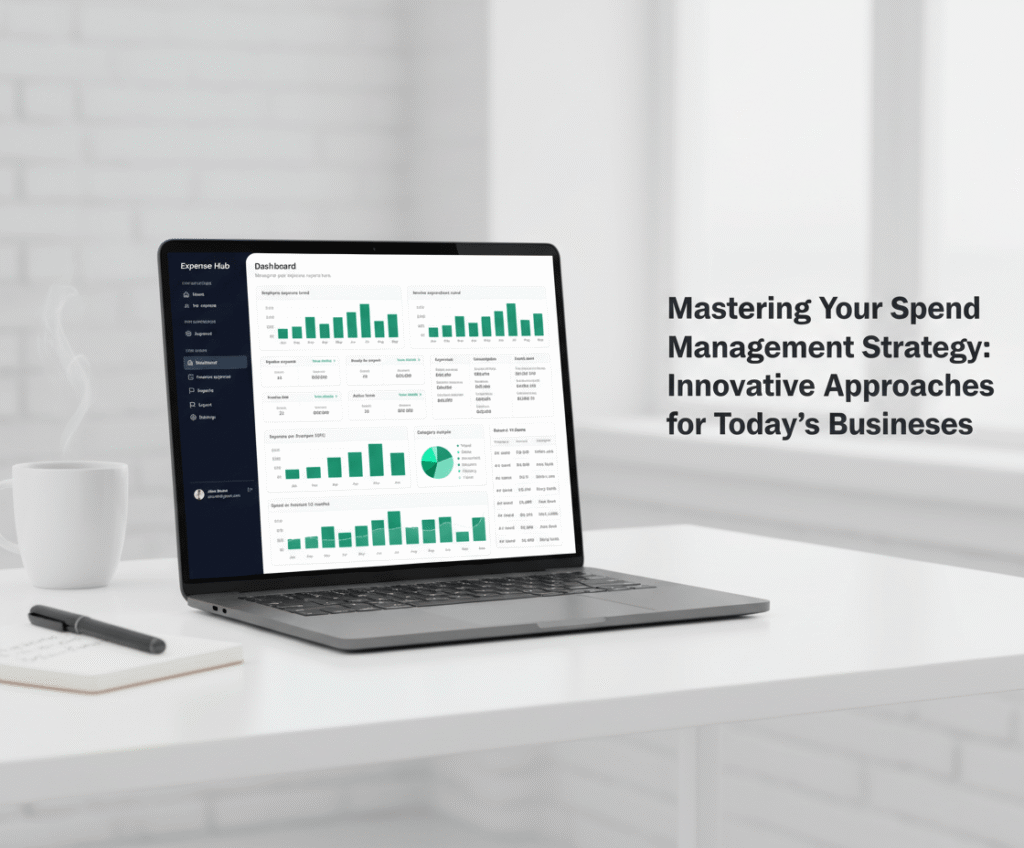
But here’s where it gets juicy — throw in smart automation and real-time analytics, and suddenly, your spend management isn’t just a tedious task. It becomes a competitive advantage. That’s precisely what Expense Hub delivers: a nerve center where you don’t just watch the road, you control the traffic lights and reroute around every pothole.
(Want to see how you can optimize spend management without spreadsheet-induced migraines? Expense Hub makes it ridiculously easy — see for yourself.)
Why a Spend Management Strategy Is Your Financial Bodyguard
Safeguarding Your Profit With Every Dollar
Picture a classic movie heist: alarms, vaults, sneaky lasers. Now, imagine the “vault” is your business’s bank account, and the threat isn’t Danny Ocean — it’s good old-fashioned overspending. A solid spend management strategy is your Alan Rickman — yippee-ki-yay, budget leaks! — ensuring every dollar behaves, every expense is justified, and no clever employee is moonwalking with your money.
But this goes beyond policing. It’s about aligning expenditures with your company’s actual goals. It’s too easy to say, “We’re buying this software because Bob from accounting likes it.” Nope. With a unified financial strategy, you’re not just spending for spending’s sake; you’re investing in what really matters. Every policy gets two jobs: choke out fraud and mistakes, and push every penny toward actual, revenue-driving priorities (https://www.rippling.com/blog/spend-management backs this up).
Real-Time Clarity = Game-Changing Decisions
Imagine playing poker with blindfolds. That’s running a business without real-time spend insights. Expense Hub pulls off the blinders and piles all your spend data in one place. Every transaction, every tiny leak, every miraculous cost-saving — it’s all there. You don’t need to wait until month’s end to find out you blew your swag budget on “team building” ax-throwing again.
With real-time analytics, your leadership team doesn’t just guess anymore. You proactively see trouble on the horizon, from spending spikes (hello, trade show season) to suspicious transactions (Bob, are we really buying 400 rubber ducks?). Using tools like Expense Hub, you can finally make the kind of data-driven decisions that land you in the “Best Run Company” clickbait lists — instead of the “Biggest Unexpected Overruns” headlines (https://www.ivalua.com/blog/business-spend-management/ see how data centralization helps here).
(Want to dive deep into future-proof financial control? Check out our primer on Understanding Financial Control Strategies and see the systems that keep expenses on a leash.)
Petty Cash Management Alternatives: Ditching Dinosaurs for Digital Dollars
What’s Wrong with Good Old Petty Cash?
Back in the day, every office had this mythical shoebox labeled “Petty Cash,” stuffed with bills, sticky notes, and just enough anxiety to feed a team of auditors. That “free money” drawer was a magnet for minor theft, bad decisions (“Did we really need that lava lamp?”), and more administrative headaches than a leaky espresso machine.
Traditional petty cash systems are a hotbed for risk and inefficiency. Want a quick reality check? According to https://coastpay.com/blog/spend-management/, these systems create security nightmares — lost cash, mysterious shortages, and the legendary “No one knows where the receipts went” phenomenon. Tracking is a circus act. And every reconciliation becomes a mini-crisis. https://blog.expensehub.io/manual-expense-tracking-vs-automation Explore further how tracking and automation can streamline these processes.
If you’re still using physical petty cash in 2024, ask yourself: Would you rather manage your spend using an abacus, too?
Read more on petty cash risks and solutions.
Innovative Alternatives: Virtual Cards & Automated Expense Platforms
Enter the era of virtual cards and cloud-based platforms — the neon-lit Las Vegas of modern spend management. Instead of handing out actual money or generic cards, you issue digital cards with limits (down to the penny if needed) and real-time oversight. If Barb from HR tries to buy donut bouquets for the third time this month? You’ll know before the sprinkles hit the invoice.
Automated platforms like Expense Hub digitize the entire process. Need to approve a small purchase? Easy — do it from your phone, complete with pre-set controls. Need an audit trail? Every transaction is automatically logged, categorized, and report-ready (no more scavenger hunts for crumpled receipts). https://blog.expensehub.io/the-role-of-automation-in-the-modern-financial-analyst-toolkit Learn further how automation can transform your finance processes.
Best of all, Expense Hub’s virtual card solution turns what used to be a headache into a competitive advantage. No more missing cash, no more mystery expenses — only clean, accountable, visible spend at your fingertips. (Read more on why this matters at https://www.brex.com/spend-trends/expense-management/spend-management.)
(Want to upgrade your spend game? Our post on Innovative Financial Solutions shows how virtual cards are leaving petty cash in the dust.)
Company Spending Limits: Putting a Firm Yet Friendly Hand on the Wallet
Why Spending Limits Are Your Budget’s Seatbelt
Let’s do some napkin math. Say you’ve got 20 employees, and every month, just one of them overspends by $100. That’s $2,000 a month — $24,000 a year — evaporating without anyone noticing. Now, what if those overages come from a half-dozen employees and they start compounding as “normal”? Left unchecked, it’s the fast lane to cash flow chaos.
Company spending limits are your business’s seatbelt — snug but flexible. Set them right, and your employees are free to spend on what’s important — but not on what’s unnecessary. You prevent rogue purchases (hello, gold-plated staplers) and put an end to unwitting mission drift (https://coastpay.com/blog/spend-management/ explains why this works).
But there’s more to it than “No, you can’t buy another office espresso machine.” Firm spending limits foster a culture where budget ownership becomes a team sport. If an expense strays outside the lines, you—or better yet, the system—can catch it before your finance team even finishes their morning muffin.
How to Build a Wall That Protects — Not Smothers
- Set Policy-Based Thresholds: Use historical data and practical sense. Don’t copy-paste last year’s limits; adjust for new realities, not old routines. https://blog.expensehub.io/understanding-compliance-in-expense-management Understand compliance more deeply to avoid financial pitfalls.
- Approval Workflows: For those gray-area purchases (“We needed six-foot yard gnomes for the trade show,” says Marketing), require a second pair of eyes.
- Monitor Patterns, Not Just Amounts: Sometimes it’s not the giant purchase, but the hundred tiny ones that bust budgets (see https://www.order.co/blog/spend-management/spend-management-strategy/ Order’s strategy breakdown).
How Expense Hub Makes Spending Limits Unbreakable (Yet Kind)
No one likes playing “compliance cop.” With Expense Hub’s customizable spending controls, you set thresholds once, then let the platform do the enforcing. Pre-approved limits, dynamic alerts, automatic notifications for potential breaches — you’re the wizard behind the curtain, not the hall monitor by the copier.
Did someone breach a spending policy? The platform doesn’t just tsk-tsk — it pings the right people, supplies evidence, and gives you actionable data for better forecasting next quarter (https://www.rippling.com/blog/spend-management as Rippling points out). All the while, your day-to-day runs smoothly — no bottlenecks, no paperwork pileups.
Plus, if you ever need to adjust a limit temporarily (think: unplanned opportunities or “that one urgent project”), it’s a couple of clicks, not a week-long saga. Flexibility and control — the sweet spot where finance teams do their best work. https://blog.expensehub.io/expense-management-for-startups-guide Learn more about strategies for managing expenses.
Employee Spending Card Controls: Turning Loose Cannons Into Accountable Heroes
The Cost of Unchecked Employee Spend
Would you hand your personal credit card to your roommate with nothing but a “Don’t spend too much” sticky note? (If so, we need to talk about your risk tolerance.) Yet businesses do a version of this all the time. An out-of-control employee spending card can quietly gnaw away at profits — $30 here on coffee runs, $250 there on “urgent” subscriptions — until suddenly, your ledger looks more like Swiss cheese than a balance sheet.
It’s not just about “bad apples,” either. Often, it’s staffers trying to do their jobs — but tripping over vague policies, unclear spending limits, or archaic approval processes. The result? Non-compliance, wasted resources, and anxious budget meetings (https://www.ivalua.com/blog/business-spend-management/ lays this out).
Building Smarter, Faster, Stronger Card Controls
- Card Limits by Role and Need: Why should an intern have the same limit as a senior project manager? Dynamic controls let you get granular.
- Transaction Category Blocking: No more “accidental” entertainment expenses on the “office supplies” card.
- Temporary Authorizations: Short-term spikes (like, say, your ops team shipping 300 promo kits) don’t become permanent loopholes.
How Expense Hub Delivers Total Visibility and Rapid Response
With Expense Hub, card controls aren’t just a line in the policy manual. They’re actively monitored, enforced, and adjusted in real time. Each card gets its own rules — down to the day, dollar, and even the merchant type. https://blog.expensehub.io/choosing-expense-management-software-UK Explore best practices for effective card controls and expense software selection.
What about transparency? Forget the month-end scramble. With live feeds, every manager (and finance lead) gets instant notification of out-of-policy use. Approvals, exceptions, and flags happen immediately — the way you always wished expense management worked but never quite believed was possible (https://www.brex.com/spend-trends/expense-management/spend-management here’s how Brex handles real-time controls).
Oh, and fraud detection? Expense Hub’s got algorithms ready to sniff out the shadiest transactions. If someone tries to expense a jet ski to “Office Development,” you’ll catch it before they can say, “But it’s for team morale!”
Controlling Maverick Spend: Herding the Wild Ponies of Business Expenses
Maverick Spend: The Hidden Saboteur
Every company has the department or individual with a “special way” of doing things — usually with an expense report buried under an avalanche of Post-Its. This is maverick spend: off-policy purchases, sneaky workarounds, and procurement gone rogue. And it’s not just an annoyance; maverick spend is a silent revenue drain. Best-in-class companies keep 77% of spend under management. The laggards? Just 56% (https://www.ivalua.com/blog/business-spend-management/ spells it out here).
Every maverick purchase means lost volume discounts, messy compliance, surprise invoices, and a slow descent into budgeting chaos. It’s like trying to run a relay race with half your team secretly tossing the baton in the bushes. https://blog.expensehub.io/expense-policy-best-practices Find more on aligning expense policies for better spend management.
Taming Maverick Spend With Policy, Analysis, and Automation
Want to corral those wild ponies? Here’s the strategy:
- Spend Analysis: Know where the leaks are, down to the department, vendor, and even transaction type. (Expense Hub’s dashboards make this “Where’s Waldo?” search instantaneous.)
- Clear Policies: Make rules folk can actually understand. No business-speak. No “see Appendix C on page 47” nonsense. Just “here’s what you can buy, here’s how, and here’s why.”
- Automated Approval Workflows: Don’t rely on memory or hallway promises. Automated processes flag suspicious spend for review — before the transaction clears.
- Ongoing Communication: Your finance policies aren’t medieval decrees — keep employees in the loop with updates, training, and prompts.
Expense Hub threads all of these together in a single system: approval chains, audit trails, and red-flag notifications (https://www.stampli.com/blog/accounting/business-spend-management-ultimate-strategy-guide/ and here’s why that works, per Stampli). Gone are the days of post-mortem spend reviews when it’s too late to fix the “oops.” https://blog.expensehub.io/financial-process-optimization-strategies Automate and enhance your financial process efficiency.
(Curious about controlling maverick spend? Discover how Expense Hub keeps your team focused, even when creativity gets a little… creative.)
Ready to Take Control of Your Finances? Here’s Your Next Step
You’ve hung in there through stories of lava lamps, rogue spenders, and cash drawers straight out of the Jurassic era. What’s the through-line? Smart, innovative spend management strategies aren’t just “nice to have” — they’re necessary shields against waste, fraud, and chaos.
Let’s recap:
- A great spend management strategy is the difference between thriving and merely surviving. It realigns every dollar with your real business goals.
- Outdated systems like petty cash don’t just slow you down — they quietly drain resources and kill visibility.
- Proactive controls, approval workflows, and team buy-in are not optional if you want compliance, security, and real cost savings.
- Platforms like Expense Hub are game changers: they automate what used to take days, highlight trouble in real time, and put easy-to-use controls directly in your team’s hands. You get the oversight and the freedom to move fast (https://www.stampli.com/blog/accounting/business-spend-management-ultimate-strategy-guide/ agrees).
Here’s your move:
Don’t let another quarter slip by hoping the spreadsheets work themselves out. Book a free demo or a quick consult with an Expense Hub expert. You’ll see instantly how easy it is to kick fraud, waste, and headaches out of your workflow — and turn spend management from a sore spot into a winning play.
Ready to swap panic for Profit First confidence? Let’s chart your new course with Expense Hub today.